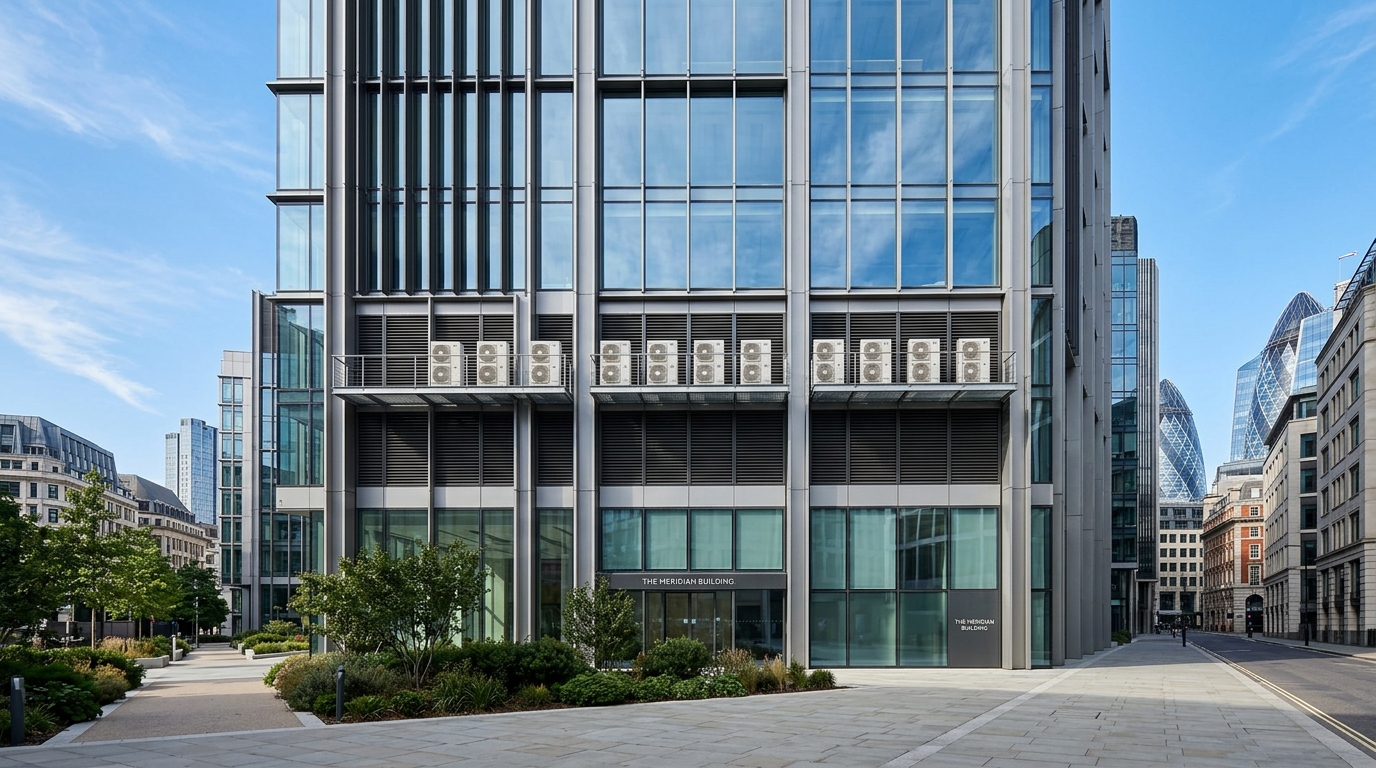
Air conditioning units are increasingly common in London homes and offices, but many building owners are unsure whether installation requires planning permission. The answer depends on the type of unit, the property, and its location. This guide covers the planning rules for both residential and commercial air conditioning installations in London, including air source heat pumps.
When Is Planning Permission Not Required?
The installation of air conditioning units on a house is permitted development under Class A of Part 14 of Schedule 2 to the General Permitted Development Order, provided all of the following conditions are met:
- The unit is installed on a wall or roof that does not face a highway
- No part of the unit is installed on a chimney, wall, or roof that forms part of the principal or side elevation facing a highway
- The unit is at least 1 metre from the edge of the roof
- The cumulative volume of all units on the dwelling does not exceed 0.6 cubic metres
- The unit does not protrude more than 0.2 metres beyond the surface on which it is installed
- The unit is not installed on a listed building or within its curtilage
In practice, many standard domestic split-system air conditioning units fall within these limits, particularly where the condenser unit is located on a rear or side wall not facing a highway. If your proposed installation satisfies all of the above conditions, you do not need planning permission. If you are uncertain, our planning consultants can confirm the position quickly.
When Is Planning Permission Required?
Planning permission is required in the following circumstances:
- The property is a listed building or within the curtilage of a listed building. In this case, Listed Building Consent may also be required. See our full guide on Listed Building Consent in London.
- The unit is to be installed on the principal elevation facing a highway
- The cumulative volume of all units would exceed 0.6 cubic metres
- The property is a flat or maisonette (Class A of Part 14 does not apply to flats)
- The property is in a conservation area and the unit would be visible from a highway
For commercial properties, air conditioning installations generally require planning permission as they constitute a material alteration to the appearance of the building. However, some minor installations may fall within the commercial Permitted Development Rights under Part 2.
Air Source Heat Pumps and Planning Permission
Air source heat pumps (ASHPs) are increasingly being installed across London as homeowners move away from gas boilers. The planning rules for ASHPs are governed by Class G of Part 14. An ASHP can be installed as permitted development provided:
- It is used solely for heating purposes (not cooling)
- The unit is not within 1 metre of a property boundary
- No more than one ASHP is installed on the property at any time
- The unit is not installed on a roof
- The unit is not installed on a listed building or within a conservation area
For ASHPs in conservation areas and Article 4 Direction zones, planning permission is required. Given the government's push toward heat pump adoption, local planning authorities are generally receptive to well-positioned ASHP installations.
Noise Conditions and Neighbour Disputes
Even where planning permission is not required, the installation of air conditioning or heat pump units is subject to noise regulations. Units must comply with the relevant British Standard for noise output. In practice, modern inverter-driven systems are significantly quieter than older equipment, but siting is still important. Units placed close to bedroom windows of neighbouring properties, or in enclosed yards where noise reflects, are more likely to generate complaints regardless of their technical compliance.
Conservation Areas and London Boroughs
In conservation areas, Permitted Development Rights for air conditioning installations are frequently removed by Article 4 Directions. In these areas, any unit visible from a highway requires planning permission, and the local planning authority will assess the visual impact on the character of the conservation area. Some boroughs, including Camden, Westminster, and Kensington and Chelsea, apply particularly strict controls. Contact us before installing any unit in a conservation area to confirm the planning position.
Lawful Development Certificates for Air Conditioning
Where an installation does fall within Permitted Development Rights, applying for a Lawful Development Certificate (LDC) provides formal written confirmation of the lawful status of the works. This is advisable where a unit is being installed in a location that might be questioned in future, or where the volume or siting of the unit is close to the permitted development limits. An LDC can prevent disputes arising at the point of sale and provides protection against enforcement action.
Finding a Qualified Installer in London
Navigating the planning rules is only one part of the process. London Air Con Installers are a specialist installation team operating across London, and we act as their planning consultants for complex projects. When their clients face installations that require planning permission, such as works in conservation areas, listed buildings, or large commercial schemes, they refer those clients to DMC Planning to secure the necessary consents. Once permission is in place, installation proceeds. If you are already working with London Air Con Installers on a project that may require planning permission, contact us and we can advise on the planning position quickly.