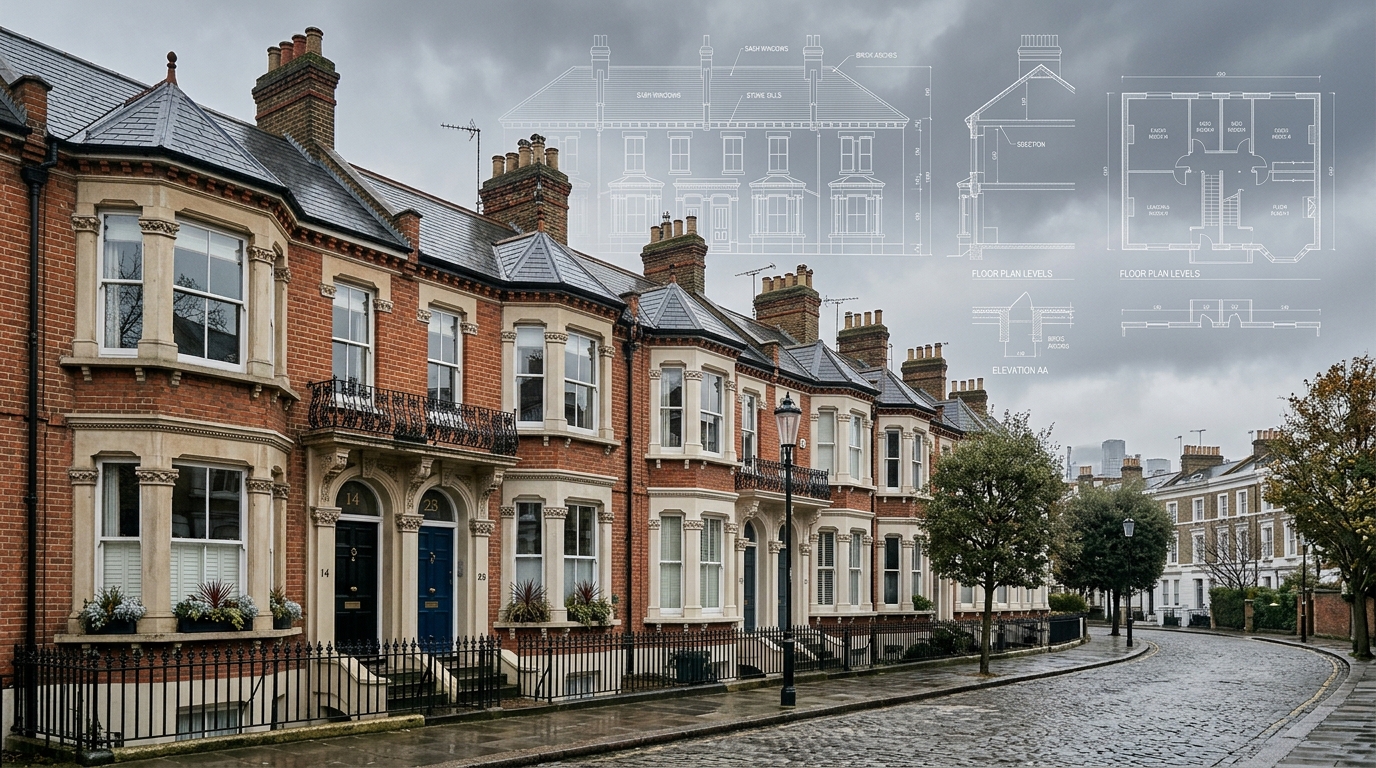
Permitted Development Rights (PDR) allow certain types of building work to proceed without a full planning application. For London homeowners and developers, understanding what falls within these rights can save significant time and cost. This guide covers the current framework, recent changes under the 2024 amendments, and the specific restrictions that apply across London boroughs.
What Are Permitted Development Rights?
PDR are granted by the Town and Country Planning (General Permitted Development) (England) Order 2015, as amended. They set out categories of development that are automatically permitted, subject to specified conditions and size limits. In London, PDR operates alongside additional controls imposed by the London Plan and individual borough Local Plans. Rights available elsewhere in England are frequently restricted or removed in London through Article 4 Directions.
If you are uncertain whether your proposed works fall within PDR, our planning consultant services include a PDR assessment as a first step before any design work is committed.
Key Categories of Permitted Development
Rear and Side Extensions
Under Class A of Part 1, a single-storey rear extension may be built without planning permission provided it does not exceed 4 metres in depth for a detached house, or 3 metres for a terraced or semi-detached property. Extensions must not exceed the height of the existing eaves or ridge. In conservation areas and Article 4 Direction areas, these rights are commonly removed entirely.
Loft Conversions
Under Class B of Part 1, loft conversions are permitted development subject to volume limits: 40 cubic metres for terraced houses and 50 cubic metres for detached and semi-detached properties. The enlarged part must not project beyond the existing roof slope on the principal elevation facing a highway. For a detailed breakdown of when permitted development applies to loft conversions, see our guide to loft conversion planning permission in London.
Class MA: Commercial to Residential Conversions
Introduced in 2021, Class MA allows the conversion of Class E commercial premises to residential use through a Prior Approval process rather than a full planning application. This right has created significant development opportunities across London, though many boroughs including Camden, Islington, and Hackney have used Article 4 Directions to protect their most important high streets and employment corridors.
Upward Extensions Under Part 20
Part 20 of Schedule 2 introduced permitted development rights to add new storeys to existing buildings. In London, these rights are more restricted than elsewhere in England. Conservation areas and Article 4 Direction zones are typically excluded. However, for properties in outer London boroughs where restrictions have not been applied, upward extensions via Prior Approval can represent a cost-effective route to additional residential units.
Article 4 Directions in London
London boroughs make extensive use of Article 4 Directions to remove PDR in sensitive locations. Common rights removed include rear and side extensions in conservation areas, alterations to windows and doors on principal elevations, conversion of houses to flats (Class L), and Class MA conversions in designated employment areas. Before assuming any works are permitted development, always check whether an Article 4 Direction applies to your property. The local planning authority can confirm this and some boroughs publish interactive mapping tools online.
Prior Approval: A Middle Ground
Some categories of permitted development require the applicant to notify the local planning authority and obtain Prior Approval before commencing works. Prior Approval is less demanding than a full planning application but still requires the council to assess specified matters, such as transport impact, flooding risk, and contamination. For Class MA conversions and upward extensions, the authority also considers the design and external appearance of the proposed works. Timescales are typically 56 days, compared to the standard 8 weeks for a householder planning application.
Lawful Development Certificates
A Lawful Development Certificate (LDC) is a formal written confirmation from the local planning authority that proposed or existing works are lawful. The same PDR framework under Part 14 governs air conditioning units and air source heat pumps; if you need a specialist installer familiar with London planning constraints, we recommend London Air Con Installers. An LDC and do not require planning permission. While not legally required before carrying out permitted development works, an LDC provides crucial protection when selling the property, remortgaging, or defending against enforcement action. We strongly recommend obtaining an LDC for any significant works carried out under PDR, particularly in London where the interpretation of conditions is frequently contested. Contact us to discuss whether an LDC is appropriate for your project.
Frequently Asked Questions
Do I need planning permission for a garage conversion in London?
In many cases, converting an integral or attached garage to a habitable room is permitted development under Class A, provided no physical extension is being constructed. However, in conservation areas, listed buildings, and Article 4 Direction zones, a full planning application is required. We recommend confirming the position with a Lawful Development Certificate application before any conversion begins.
Can I build a garden room or outbuilding without planning permission?
Outbuildings including garden rooms, studios, and garden offices are permitted development under Class E of Part 1, subject to conditions. The outbuilding must not cover more than 50% of the total garden area, must not be positioned in front of the principal elevation, and must not exceed 4 metres in height with a dual-pitched roof or 3 metres otherwise. If it is within 2 metres of a boundary, the maximum height is reduced to 2.5 metres. In conservation areas, outbuilding rights are routinely restricted.
What are the risks of carrying out works without checking PDR status?
If works that require planning permission are carried out without consent, the local planning authority can take enforcement action, requiring the demolition or alteration of the works at the owner's expense. For operational development, enforcement action can be taken up to 4 years after substantial completion. The enforcement risk profile is significantly higher in conservation areas where boroughs are more likely to monitor works and respond to complaints from neighbours.